
Effect of Vetch and Grass Pea Intercropping with Barley on Yield, Seed Multiplication Ratio, Broad-Leaved Weed Suppression
-
Hoda Abou Younes

International Center for Agricultural Research for Dry Areas, Zahle 1801, Bekaa, Lebanon
Abdoul Aziz NianeInternational Center for Agricultural Research for Dry Areas, Ministry of Climate Change and Environment, Sheikh Zaid Road, United Arab Emirates
Khaled Al ShamaaInternational Center for Agricultural Research for Dry Areas, 2 Port Said, Victoria Sq, Ismail El-Shaaer Building, Maadi, Egypt
Muhamad ImtiazInternational Center for Agricultural Research for Dry Areas, National Agriculture Research Center, Park Road, Pakistan
| Received 21 Jul, 2026 |
Accepted 20 Sep, 2026 |
Published 29 Sep, 2026 |
Background and Objective: Intercropping cereals with legumes can improve crop productivity, suppress weeds, and enhance the efficient use of soil resources. This study aimed to evaluate the effects of different mixture rates of vetch and grass pea with barley on grain yield, biomass yield, seed multiplication ratio, and broadleaf weed suppression. Materials and Methods: Four mixture ratios of legume and barley were evaluated: 100:0, 75:25, 50:50, and 25:75. The effects of increasing seeding rates and different crop mixtures on grain and biomass yields, seed multiplication ratio, and broadleaf weed biomass and stem density were assessed. The trial followed a randomized complete block design with two treatment factors: Biomass yield potential (2 levels: High biomass and low biomass) and [barley:legume] mixture ratio (4 levels: 100:0, 75:25, 50:50, and 25:75), replicated 3 times in 2019 and 4 times in 2020 and 2021. The effects of increasing seeding rates and different crop mixtures was evaluated against 5 parameters: Grain yield, biomass yield, seed multiplication ratio, broadleaf weed biomass yield and broadleaf weed stem density. Results: Increasing the seeding rate significantly increased the relative grain and biomass yields of the three crops. Mixed cropping produced significantly higher total forage yields than the respective pure stands. The seed multiplication ratio was highest under the 25:75 mixture ratio. Intercropping also significantly reduced broadleaf weed biomass and the number of weed stems. However, no significant differences in weed suppression were observed among the different mixture ratios. Conclusion: The findings demonstrate beneficial interactions between barley and legume crops in mixed cropping systems. Barley may contribute to weed suppression and provide physical support to the legume crops, while vetch and grass pea may improve soil fertility through biological nitrogen fixation. Appropriate barley-legume mixtures may therefore provide a promising strategy for improving forage productivity and weed management.
| Copyright © 2026 Younes et al. This is an open-access article distributed under the Creative Commons Attribution License, which permits unrestricted use, distribution, and reproduction in any medium, provided the original work is properly cited. |
INTRODUCTION
Barley (Hordeum vulgare L.) is one of the most important cereals crops in the world for being grown in a large diversified geographic area1. It is a fast growing and highly adaptable crop2,3 that is well adapted to Mediterranean low rainfall environments as well as highlands and mountains and is grown in marginal low-input production systems1,4,5. It is considered a weed suppressant due to its well-holding root system and its allelopathy with weeds through its ability to a quick establishment during the early stages of growth and shading out the weeds6.
Legumes, on the other hand, are characterized by having a symbiotic reaction with bacteria called Rhizobia, which allows the legumes to fix the atmospheric nitrogen (known as “Biological Nitrogen Fixation”), making it available to the plant7-9. In addition, legumes play an important role in crop rotation systems, especially in cereal-based systems, by breaking the cycle of weeds, pests, and diseases10.
Mixed cropping of cereal crops with legumes is an agricultural practice where the two crops (one cereal crop and one legume crop) are grown in the same space at the same time, and without a specific crop arrangement, favoring biological interactions11-14. Mixed cropping practices play a role in increasing resource utilization, improving soil physical and microbial properties, and increasing weed suppression, all leading to higher yields6,12,15.
While legumes increase the soil’s nitrogen content through biological N fixation, cereal crops absorb the available nitrogen and play the role of nutrient recycler in soils with high nitrogen levels; in this context, a mixture of cereals and legumes intercropped creates a balance in the soil’s nitrogen content6. It has been also proved that intercropping enhances the number of microbial communities in the soil, which improves the soil nutrient status, leading the higher yields12,16.
Additionally, in mixed cropping with legumes, barley plays the role of a “nurse crop” and provides physical support to legume crops like vetch and grass pea, which enhances its stand, increases its light exposure, and facilitates its mechanical harvestability6.
Finally, intercropping two crops that share the field only part of the season, like the association of forages with oats, barley, or wheat, is an effective weed suppression strategy that optimizes the resources usage of sunlight and nutrients during the early stages of the forage development13.
This study was planned to evaluate the effect of different mixture rates of vetch and grass pea mixed cropped respectively with barley on grain yield components, biomass yield, seed multiplication ratio, and broad-leaved weed suppression.
MATERIALS AND METHODS
Study area and duration: This study was conducted in three different locations in the Bekaa area throughout three growing seasons (2018/2019, 2019/2020, and 2020/2021). In all three environments dominate a Mediterranean Climate.
Study design: A local variety of a 2-row Barley (Hordeum vulgare, harmal), 2 accessions of vetch (Vicia sp.) and grass pea (Lathyrus sp.) were studied (Table 1). In addition to the crop effect, the legume biomass yielding potential and the seeding rate ratio between the barley and the legumes were also studied.
The randomized complete block design was adopted, and the experimental plot consisted of 4 rows of 5 m length and 0.3 m spacing between the rows. Vetch and grass pea were planted as pure stands, and mixed cropped with barley at [25:75], [50:50], and [75:25] of [Legume:Barley] ratios.
| Table 1: | List of planting materials | |||
| Crop | Biomass yielding potential | Designation |
| Vetch | High biomass | IG60209 |
| Low biomass | IG60433 | |
| Grass pea | High biomass | Bang-227 |
| Low biomass | Bang-226 |
| Table 2: | Experimental design, studied factors and treatments | |||
| Crop | Factor 1: Biomass yielding potential | Factor 2: Seeding mixture ratios |
| Vetch (Vicia sp.) | High biomass | 100% Legumes |
| 75% Legumes+25% Barley | ||
| 50% Legumes+50% Barley | ||
| 25% Legumes+75% Barley | ||
| Low biomass | 100% Legumes | |
| 75% Legumes+25% Barley | ||
| 50% Legumes+50% Barley | ||
| 25% Legumes+75% Barley | ||
| Grass pea (Lathyrus sp.) | High biomass | 100% Legumes |
| 75% Legumes+25% Barley | ||
| 50% Legumes+50% Barley | ||
| 25% Legumes+75% Barley | ||
| Low biomass | 100% Legumes | |
| 75% Legumes+25% Barley | ||
| 50% Legumes+50% Barley | ||
| 25% Legumes+75% Barley |
The seeding rates at pure stands were 100 seeds/m2 for legumes and 300 seeds/m2 for barley. The ratio used in the mixtures represents the percentage of the pure stand seeding rate for each crop. The different factors and treatment combinations are summarized in Table 2.
Statistical analysis: The statistical analysis was done using the WALD test through the REML analysis procedure with the modeling parameters consisting of the crop, biomass yielding potential, and the mixture ratios as fixed effects and the year and the replication as random effects. The table of means was associated with the SED divergence metrics. The calculated LSD (using the formula LSD ≈ 2*SED), 5% probability was used to compare means between the different treatment factors.
Experiment: The agricultural practices were homogenized across the three seasons. A deep ploughing was performed during September, followed by an application of a top-dressing of 200 kg/ha of slow-release compound fertilizer (15N-15P-15K) during November. Soil cultivation using the rotary plough was performed for seedbed preparation. Seed sowing occurred in early December using a mechanical linear sowing machine. No pest control (herbicide, pesticide, and/or fungicide) was administered to the mixture of crops. Finally, one complementary irrigation of 40 mm aimed at enhancing heading for barley, and flowering and fruit set for the legume crops took place in April.
Data analysis: Data for different parameters were collected and analyzed as described below:
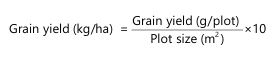
∙ Grain yield (kg/ha): The grain yield in kg/ha for clean seeds for each of the legumes and barley crops was calculated using the formula17:
 |
∙ Total grain yield (kg/ha): The total grain yield was calculated by adding both the legumes yield (kg/ha) and barley yield (kg/ha) together
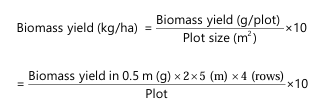
∙ Biomass yield (kg/ha): To calculate the biomass yield, 0.5 linear meters were collected randomly by hand from the inner rows of the plot at the full maturity stage and weighed using the electronic balance. No biomass separation was made between the legumes and barley crops; the biomass yield of the mixed crops was studied. Considering that the plot length is 5 m, the number of rows in each plot is 4 and the total plot area is 6 m2, the biomass yield per hectare (kg/ha) was calculated using this formula17:
 |
∙ The seed multiplication ratio (SMR), which represents the quantity of seeds produced (g) from a single seed planted, was calculated using the following formula18:
 |
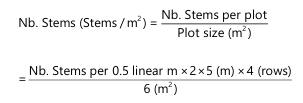
∙ The weed suppression effect was studied by collecting randomly 0.5 linear meters at the full maturity stage, the number of broad-leaved weeds’ stems were counted, and their biomass yield was weighed. The formula used to calculate the number (Nb) of stems per m2 is17:
 |
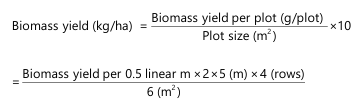
∙ The formula used to calculate the broad-leaved weeds’ biomass yield in kg/ha is17:
 |
RESULTS
Effect of crop mixtures on grain and biomass yield: Growing crop mixtures of legumes (Vicia sp. and Lathyrus sp.) and spring barley (Hordeum vulgare) had a significant effect on the legumes’ grain yield (F pr<0.001), re-gardless of the crop. The legumes’ grain yield showed a significant decrease (LSD = 95.44) when the mixture ratio of the legume crop decreased (Table 3).
Regarding the barley’s grain yield, it was also significantly affected by the mixture ratio: The grain yield of barley increased with the increase in the mixture ratio (Table 3).
There was an interaction between the crop and the mixture ratio. vetch and grass pea were both affected by the mixed cropping system (F pr = 0.002) where the highest legumes grain yield was observed when vetch and grass pea were planted with pure crop stands (Avg. Yield (vetch) = 981.1 kg/ha; Avg. Yield (grass pea) = 824.0 kg/ha) while the lowest grain yield was observed when the legumes were planted in a 25:75 ratio (Avg. Yield (vetch) = 177.6 kg/ha; Avg. Yield (grass pea) = 168.0 kg/ha). The difference in grain yield was not significant when the legumes were planted in a ratio of [75:25] and [50:50].
| Table 3: | Average grain yields per mixture ratios | |||
| Mixture ratio | ||||||
| 100% legumes | 75% Leg.+25% Bar. | 50% Leg.+50% Bar. | 25% Leg.+75% Bar. | F pr | LSD | |
| Avg. grain yield (kg/ha) | ||||||
| Legumes | 902.6a | 468.7b | 367.0c | 172.8d | <0.001 | 95.44 |
| Vetch | 981.1a | 422.4b | 312.5b | 177.6c | 0.022 | 134.98 |
| Grass Pea | 824.0e | 515.1f | 421.4f | 168.0g | ||
| Barley | - | 1091a | 1453b | 1613c | <0.001 | 141.4 |
| Different lowercase letters within the same row indicate significant differences among mixture ratios according to the Least Significant Difference (LSD) test at p<0.05. Leg. = Legumes, Bar. = Barley, LSD = Least significant difference, F = F-statistic, p<0.05 indicates statistical significance. “-” Indicates that the treatment was not applicable | ||||||
| Table 4: | Decrease (in %) of the legumes grain yield in mixed cropping compared to the pure stands | |||
| Grain yield decrease | 75% Leg+25% Bar. | 50% Leg.+50% Bar. | 25% Leg.+75% Bar. |
| Vetch | -57% | -68% | -82% |
| Grass pea | -38% | -49% | -80% |
| -: Sign indicate decrease in percentage | |||
| Table 5: | Averages of the total grain yields and total biomass yields for the barley and the legume crops | |||
| Mixture ratio | ||||||
| Total yields (kg/ha) | 100% legumes | 75% Leg.+25% Bar. | 50% Leg.+50% Bar. | 25% Leg.+75% Bar. | F pr | LSD |
| Grain yield | 946a | 1532b | 1691b | 1684b | <0.001 | 239.6 |
| Biomass yield | 7974.49a | 10899.36b | 11513.29b | 10983.04b | <0.001 | 8.492 |
| Different lowercase letters within the same row indicate significant differences among mixture ratios according to the Least Significant Difference (LSD) test at p<0.05. The effect of mixed cropping legumes with barley on the total grain yield and the total biomass yield was not affected by the biomass-yielding potential of the crop since there was no significant interaction between the mixture ratio and the biomass-yielding potential (F pr(Grain yield-leg.) = 0.642, F pr(Grain yield-bar.) = 0.804, F pr(Grain yield-tot.) = 0.951, F pr(Total Biomass Yield.) = 0.932) | ||||||
There was an interaction between the crop and the mixture ratio. vetch and grass pea were both affected by the mixed cropping system (F pr = 0.002) where the highest legumes grain yield was observed when vetch and grass pea were planted with pure crop stands (Avg. Yield (vetch) = 981.1 kg/ha; Avg. Yield (grass pea) = 824.0 kg/ha) while the lowest grain yield was observed when the legumes were planted in a 25:75 ratio (Avg. Yield (vetch) = 177.6 kg/ha; Avg. Yield (grass pea) = 168.0 kg/ha). The difference in grain yield was not significant when the legumes were planted in a ratio of [75:25] and [50:50].
When comparing the grain yield between the two legumes crops, the decrease in grain yield was more important in vetch than in grass pea where the vetch grain yield decreased by 57% for the [75:25] ration, 68% for the [50:50] ratio and 82% for the [25:75] ration, compared to a 38%, 49% and 80% of decrease in the grain yield for the [75:25], [50:50] and [25:75] ratios respectively (Table 4).
Mixed cropping of legumes with barley revealed to have a significantly positive effect on the total grain yield (sum of the grain yield of both barley and the legume crop) and the total biomass yields (sum of the biomass yield of both barley and the legume crop) (F pr<0.001). Total grain yields and total biomass yields were significantly lowest in the pure crop sands, while both yields increased with the introduction of barley in the mixed crop-ping. In addition, the yields were not statistically different between the different mixture ratios. Whether we substituted 25%, 50%, or 75% of the legume’s seeds by barley seeds, the difference in the total grain yields and biomass yields remained statistically the same (Table 5).
Effect of mixed cropping on the seed multiplication ratio (SMR): The seed multiplication ratio (SMR) for both legume crops and barley was signifi-cantly affected by the mixed cropping system (F pr<0.001).
| Table 6: | Average seed multiplication ratios for the different crops and mixture ratios | |||
| Mixture ratio | ||||||
| SMR (legumes) | 100% legumes | 75% Leg.+25% Bar. | 50% Leg.+50% Bar. | 25% Leg.+75%Bar. | F pr | LSD |
| Vetch | 1.1031a | 0.6254b | 0.6918b | 0.6601b | 0.046 | 0.219 |
| Grass pea | 0.9433a | 0.7764a | 0.9505a | 0.8033a | ||
| Barley | - | 0.485a | 0.939b | 2.073c | <0.001 | 0.1854 |
| Total | 1.053a | 0.525b | 0.866a | 1.723c | <0.001 | 0.18182 |
| Different lowercase letters within the same row indicate significant differences among mixture ratios according to the Least Significant Difference (LSD) test at p<0.05 | ||||||
| Table 7: | Average biomass yields and number of stems of broad-leaved weeds per mixture ratio | |||
| Mixture ratio | ||||||
| Broad-leaved weeds | 100% legumes | 75% Leg.+25% Bar. | 50% Leg.+50% Bar. | 25% Leg.+75% Bar. | F pr | LSD |
| Biomass yield (kg/ha) | 986.1a | 509.4b | 317.7b | 328.5b | <0.001 | 259.6 |
| Nb. Stems/m2 | 89.96a | 33.46b | 22.19b | 25.05b | <0.001 | 1.582 |
| Different lowercase letters within the same row indicate significant differences among mixture ratios according to the least significant difference (LSD) test at p<0.05. Leg. = Legumes, Bar. = Barley, LSD = Least significant difference, F = F-statistic, p<0.05 indicates statistical significance. The biomass-yielding potential of the legumes crop did not interfere with the effect of the mixture ratios on the broad-leaved weeds density (F pr = 0.758 and F pr = 0.122 for the biomass yield and number of stems, respectively) | ||||||
While the SMR for the grass pea remained statistically similar across all the mixture ratios, the SMR for the vetch de-creased on average by 40% when moving from the pure crop stand planting to the mix-ture, with no significant difference between the different mixture ratios. On the other hand, the cereal SMR increased significantly when the density of barley increased (Table 6).
The crop mixtures had a significant effect on theSMRindependently from the different crops (F pr<0.001, LSD = 0.18182).The lowest SMR reached a value of 0.525 when the mixture consisted of 75% legumes and 25% barley. When the barley density increased from 25% to 75%, the total SMR increased from 0.525 to 1.723 (Table 6). In addition, the SMR for the pure crop stand planting (SMR[100:0] = 1.053) and forthe [50:50] mixture ratio (SMR[50:50] = 0.866) were not significantly different.
The effect of mixed cropping of legumes with barley on the SMR was not affected by the biomass-yielding potential of the crop since there was no significant interaction be-tween the mixture ratio and the biomass-yielding potential (F pr(SMR-LEG.) = 0.981; F pr(SMR-BAR.) = 0.613; F pr(SMR-TOT.) = 0.604).
Effect of mixed cropping on the broad-leaved weeds: The biomass yield of broad-leaved weeds (main weeds found are wild chamomile, gallium and field bindweed) as well as the number of stems of broad-leaved weeds per unit area was significantly affected by the mixed cropping (F pr< 0.001) (Table 7).
While the weeds’ biomass yield and number of setmswere not significantly different between the [75:25], [50:50] and [25:75] mixture ratios, the broad-leaved weed density was significantly the highest with the pure crop stands where the weeds biomass yield reached 986.1 kg/ha and the number of stems reached 89.96 stems/m2 (Table 7). Compared with the [100:0] ratio, the weeds’ biomass yield significantly dropped by 51% with the [75:25] ratio (from 986.1 kg/ha to 509.4 kg/ha), by 68% with the [50:50] ratio (from 986.1 kg/ha to 317.7 kg/ha) and by 67% with the [25:75] ratio (from 986.1 kg/ha to 328.5 kg/ha). On the other hand, the weeds’ number of stems significantly dropped by 63% with the [75:25] ratio (from 89.96 kg/ha to 33.46 kg/ha), by 75% with the [50:50] ratio (from 89.96 kg/ha to 22.19 kg/ha) and by 72% with the [25:75] ratio (from 89.96 kg/ha to 25.05 kg/ha) (Table 7).
DISCUSSION
This study aimed to evaluate the effect of mixed cropping vetch (Vicia sp.) with barley (Hordeum vulgare) and grass pea (Lathyrus sp.) with barley on the yield, seed multiplication ratios, and broad-leaved weed suppression. Three mixture [Legume: Barley] ratios ([75:25], [50:50], [25:75]) in addition to the pure stand planting [100:0] were studied.
The legumes grain yields for both vetch and grass pea were negatively affected by the mixed cropping, where the highest grain yield was observed in the legume’s pure stands and the lowest with the [25:75] ratio. For the legume crops as well as the barley crop, the grain yield significantly increased with the increase of their relative seeding rate.
These findings suggest that barley has higher competition over the vetch and grass pea crops when grown as mixed crops because pure legume stands produced higher grain yields than mixed cropping systems. This could be attributed to the high adaptability and fast-growing properties of barley2,3 in addition to its strong, fibrous root system and its ability to quickly establish during the early stages of growth6.
On the other hand, mixed cropping improved the total grain yield and total biomass yield, where the lowest yields were observed in the [100:0] mixture ratio. The mixture ratios did not have a significant effect on yield, and all mixture ratios generated statistically the same yields.
Several studies have reached the same conclusion that mixed cropping systems had higher forage yields than pure stands19,20. Turk and Tawaha21 reported that mixed cropping of hairy vetch with barley had 96% higher yields than pure stands of legumes. While in our study the three mixture ratios were not significantly different in terms of total yields, Seyedeh et al.20 who studied the same mixture ratios, found that the highest yields were obtained with the [50:50] ratio, with no significant difference between the [25:75] and [75:25] ratios.
In addition, some studies that evaluated the nutrient intake of mixed cropping and sole cropping concluded that mixing legumes with barley improved the use of resources and increased nutrient absorption from the soil20-22.
Moreover, the fact that vetch and grass pea are both climbing and lodging plants23,24 makes mechanical harvestability less effective and results in losses in harvested grains and biomass. In mixed cropping, barley plays the role of physical support for the vetch and grass pea crops and improves their establishment and mechanical harvestability resulting in higher forage yields25,26.
When evaluating the SMR, different trends were observed. When studied separately, the legumes and the barley SMR both increased with the increase of their relative ratios. The highest legumes SMR was observed in the pure stands [100:0] while the legumes’ lowest SMR, and the barley’s highest SMR, were with the [25:75] ratio. When combining both the legumes and the barley yields, the total SMR had a different trend. The highest SMR was with the [25:75] ratio, and the lowest was in the [75:25] ratio. The pure stand [100:0] and the [50:50] ratio had a statistically similar SMR. This implies that the higher the proportion of barley in the mixture, the higher the SMR.
The significant difference in the SMR emphasizes the synergic effect between the legumes crop and the barley, and the significant effect of the different mixture ratios, even though they had no significant effect on the yields. Several studies have confirmed the significant influence of seed rate on the seed multiplication ratio, where decreasing seed rates significantly increased the SMR with no significant effect on the seed yield27,28.
Weed suppression is another advantage observed in this study of mixed cropping systems. The broad-leaved weeds’ biomass yield and the number of stems significantly decreased with the mixed cropping system, compared to the pure stand legumes. However, no significant effect was reported between the different mixture ratios.
Regardless of the mixture ratio, the introduction of barley in the mixture suppressed the broad-leaved weeds. This can be attributed to the barley’s fast establishment ability in the early stages of the cycle and competing with the broad-leaved weeds and consequently preventing their early development6. The same findings were concluded by27 where mixed-cropped barley and chickpea resulted in a 66% decrease in the total weed density and a 90% decrease in the weed biomass.
CONCLUSION
In conclusion, mixed cropping of vetch and grass pea with barley has an advantage over pure stand crops. Mixed cropping systems lead to an increase in the total forage yield and a decrease in the number of stems and the biomass yield of broad-leaved weeds. The seed multiplication ratio was also influenced by the mixed cropping system.
Based on these findings, the [25:75] legume-to-barley ratio emerges as the most suitable mixture, combining strong forage yield, effective weed suppression, and the highest seed multiplication ratio, making it the most efficient option for both forage production and seed increase programs. Further research is recommended to validate this ratio's performance across a wider range of agroecological zones, soil types, and rainfall regimes, and to evaluate its long-term effects on soil fertility and cropping system sustainability under farmer-managed field conditions.
SIGNIFICANCE STATEMENT
Farmers in dry, low-rainfall regions often struggle to grow enough forage and feed for their animals while also keeping soil healthy and weeds under control. This study shows that growing barley together with vetch or grass pea in the same field, rather than growing each crop alone, offers clear practical benefits. The two legume crops naturally enrich the soil with nitrogen, while barley acts as a physical support that keeps the climbing legumes upright, making harvesting easier and reducing crop losses. Barley also establishes quickly, which helps crowd out weeds that would otherwise compete with the crops for light, water, and nutrients. Testing four different planting ratios over three growing seasons, this research found that mixed cropping consistently produced more total forage than growing any single crop alone, while also producing significantly less weed growth than legumes planted by themselves. It further identified the seed ratio that gave farmers the best return in terms of seed available for future planting. These findings offer farmers and land managers a practical, low-cost strategy to boost forage production, improve soil fertility naturally, reduce reliance on weed control, and secure their own seed supply for the next planting season, supporting more resilient and sustainable farming systems in dry-area environments.
REFERENCES
- Grando, S. and H. Gómez-Macpherson, 2005. Food Barley: Importance, Uses and Local Knowledge. ICARDA, Beirut, Lebanon, Pages: 156.
- Naeem, M., N. Mehboob, M. Farooq, S. Farooq, S. Hussain, H.M. Ali and M. Hussain, 2021. Impact of different barley-based cropping systems on soil physicochemical properties and barley growth under conventional and conservation tillage systems. Agronomy, 11.
- Tricase, C., V. Amicarelli, E. Lamonaca and R.L. Rana, 2018. Economic Analysis of the Barley Market and Related Uses. In: Grasses as Food and Feed, Tadele, Z. (Ed.), IntechOpen, London, United Kingdom, ISBN: 978-1-78984-799-4 .
- Nikkhah, A., 2012. Barley grain for ruminants: A global treasure or tragedy. J. Anim. Sci. Biotechnol., 3: 22-29.
- Al-Sayaydeh, R., A. Al-Bawalize, Z. Al-Ajlouni, M.W. Akash, J. Abu-Elenein and A.M. Al-Abdallat, 2019. Agronomic evaluation and yield performance of selected barley (Hordeum vulgare L.) landraces from Jordan. Int. J. Agron., 2019.
- Clark, A., 2012. Managing Cover Crops Profitably. 3rd Edn., Sustainable Agriculture Research and Education, United States, ISBN: 978-1-888626-12-4, Pages: 244.
- Yuvaraj, M., M. Pandiyan and P. Gayathri, 2020. Role of Legumes in Improving Soil Fertility Status. In: Legume Crops-Prospects, Production and Uses, Hasanuzzaman, M. (Ed.), IntechOpen, London, United Kingdom, ISBN: 978-1-83968-274-2.
- Graham, P.H. and C.P. Vance, 2003. Legumes: Importance and constraints to greater use. Plant Physiol., 131: 872-877.
- Maroti, G. and É. Kondorosi, 2014. Nitrogen-fixing Rhizobium-legume symbiosis: Are polyploidy and host peptide-governed symbiont differentiation general principles of endosymbiosis? Front. Microbiol., 5.
- Stagnari, F., A. Maggio, A. Galieni and M. Pisante, 2017. Multiple benefits of legumes for agriculture sustainability: An overview. Chem. Biol. Technol. Agric., 4.
- Toker, P., H. Canci, I. Turhan, A. Isci, M. Scherzinger, M. Kordrostami and E. Yol, 2024. The advantages of intercropping to improve productivity in food and forage production-a review. Plant Prod. Sci., 27: 155-169.
- Chamkhi, I., S. Cheto, J. Geistlinger, Y. Zeroual, L. Kouisni, A. Bargaz and C. Ghoulam, 2022. Legume-based intercropping systems promote beneficial rhizobacterial community and crop yield under stressing conditions. Ind. Crops Prod., 2022.
- Mohler, C.L. and S.E. Johnson, 2009. Crop Rotation on Organic Farms: A Planning Manual. Sustainable Agriculture Research and Education, Ithaca, New York, ISBN: 978-1-933395-21-0, Pages: 154.
- Yazgi, A., T. Gunhan, B. Kir, G.D. Topcu and E. Aykas, 2025. Evaluation of a seed drill for barley and vetch sowing as a function of varying seeding ratios. PeerJ, 13.
- Lima, P.L.T., M.L.N. Silva, N. Curi and J. Quinton, 2014. Soil loss by water erosion in areas under maize and jack beans intercropped and monocultures. Agric. Sci., 38: 129-139.
- Sun, Y.M., N.N. Zhang, E.T. Wang, H.L. Yuan, J.S. Yang and W.X. Chen, 2009. Influence of intercropping and intercropping plus rhizobial inoculation on microbial activity and community composition in rhizosphere of alfalfa (Medicago sativa L.) and Siberian wild rye (Elymus sibiricus L.). FEMS Microbiol. Ecol., 70: 218-226.
- Gomez, K.A. and A.A. Gomez, 1984. Statistical Procedures for Agricultural Research. 2nd Edn., John Wiley and Sons, New York, USA, ISBN-13: 9780471870920, Pages: 704.
- Megerssa, S.H., T. Geleta and N. Bekele, 2023. Influence of seed rate and row spacing on seed multiplication factor and yield of durum wheat in Ethiopia. Agrosyst. Geosci. Environ., 6.
- Jilani, M., A.H. Norouzi and A. Faraji, 2018. Effect of bed planting on the quantity and quality of hay in different mixing ratios of vetch and barley in the North of Iran. Appl. Ecol. Environ. Res., 16: 4477-4490.
- Seyedeh, D. Habibi, A. Kashani, F. Paknejad and H. Jafary et al., 2010. Evaluation of hairy vetch (Vicia villosa Roth) in pure and mixed cropping with barley (Hordeum vulgare L.) to determine the best combination of legume and cereal for forage production. Am. J. Agric. Biol. Sci., 5: 169-176.
- Turk, M.A., A. Rahman and M. Tawaha, 2002. Effect of variable sowing ratios and sowing rates of bitter vetch on the herbage yield of barley-bitter vetch mixed cropping. Asian J. Plant Sci., 1: 467-469.
- Tosti, G., P. Benincasa and M. Guiducci, 2010. Competition and facilitation in hairy vetch-barley intercrops. Ital. J. Agron., 5: 239-247.
- Campbell, C.G., 1997. Grass pea, Lathyrus sativus L. International Plant Genetic Resources Institute, Rome, Italy, ISBN: 978-92-9043-341-5, Pages: 92.
- Haffani, S., M. Mezni, I. Slama, M. Ksontini and W. Chaïbi, 2014. Plant growth, water relations and proline content of three vetch species under water-limited conditions. Grass Forage Sci., 69: 323-333.
- Atis, I., K. Kokten, R. Hatipoglu, S. Yilmaz, M. Atak and E. Can, 2012. Plant density and mixture ratio effects on the competition between common vetch and wheat. Aust. J. Crop Sci., 6: 498-505.
- Yilmaz, S., A. Özel, M. Atak and M. Erayman, 2015. Effects of seeding rates on competition indices of barley and vetch intercropping systems in the Eastern Mediterranean. Turk. J. Agric. For., 39: 135-143.
- Hamzei, J. and M. Seyedi, 2015. Evaluation of the effects of intercropping systems on yield performance, land equivalent ratio, and weed control efficiency. Agric. Res., 4: 202-207.
- Constable, F.E., J.R. Whiting, K.S. Gibb and R.H. Symons, 2002. A new grapevine yellows phytoplasma from the Buckland valley of Victoria Australia. Vitis, 41: 147-153.
How to Cite this paper?
APA-7 Style
Younes, H. A., Niane, A. A., Al Shamaa, K., & Imtiaz, M. (2026). Effect of vetch and grass pea intercropping with barley on yield, seed multiplication ratio, broad-leaved weed suppression. Research Journal of Seed Science, 19(1), 13–22. https://doi.org/10.3923/rjss.2026.13.22
ACS Style
Younes, H. A.; Niane, A. A.; Al Shamaa, K.; Imtiaz, M. Effect of Vetch and Grass Pea Intercropping with Barley on Yield, Seed Multiplication Ratio, Broad-Leaved Weed Suppression. Res. J. Seed Sci 2026, 19 (1), 13–22. https://doi.org/10.3923/rjss.2026.13.22
AMA Style
Younes HA, Niane AA, Al Shamaa K, Imtiaz M. Effect of vetch and grass pea intercropping with barley on yield, seed multiplication ratio, broad-leaved weed suppression. Research Journal of Seed Science. 2026;19(1):13–22. doi:10.3923/rjss.2026.13.22
Chicago/Turabian Style
Younes, Hoda Abou, Abdoul Aziz Niane, Khaled Al Shamaa, and Muhamad Imtiaz. 2026. “Effect of Vetch and Grass Pea Intercropping with Barley on Yield, Seed Multiplication Ratio, Broad-Leaved Weed Suppression.” Research Journal of Seed Science 19 (1): 13–22. https://doi.org/10.3923/rjss.2026.13.22

This work is licensed under a Creative Commons Attribution 4.0 International License.

